



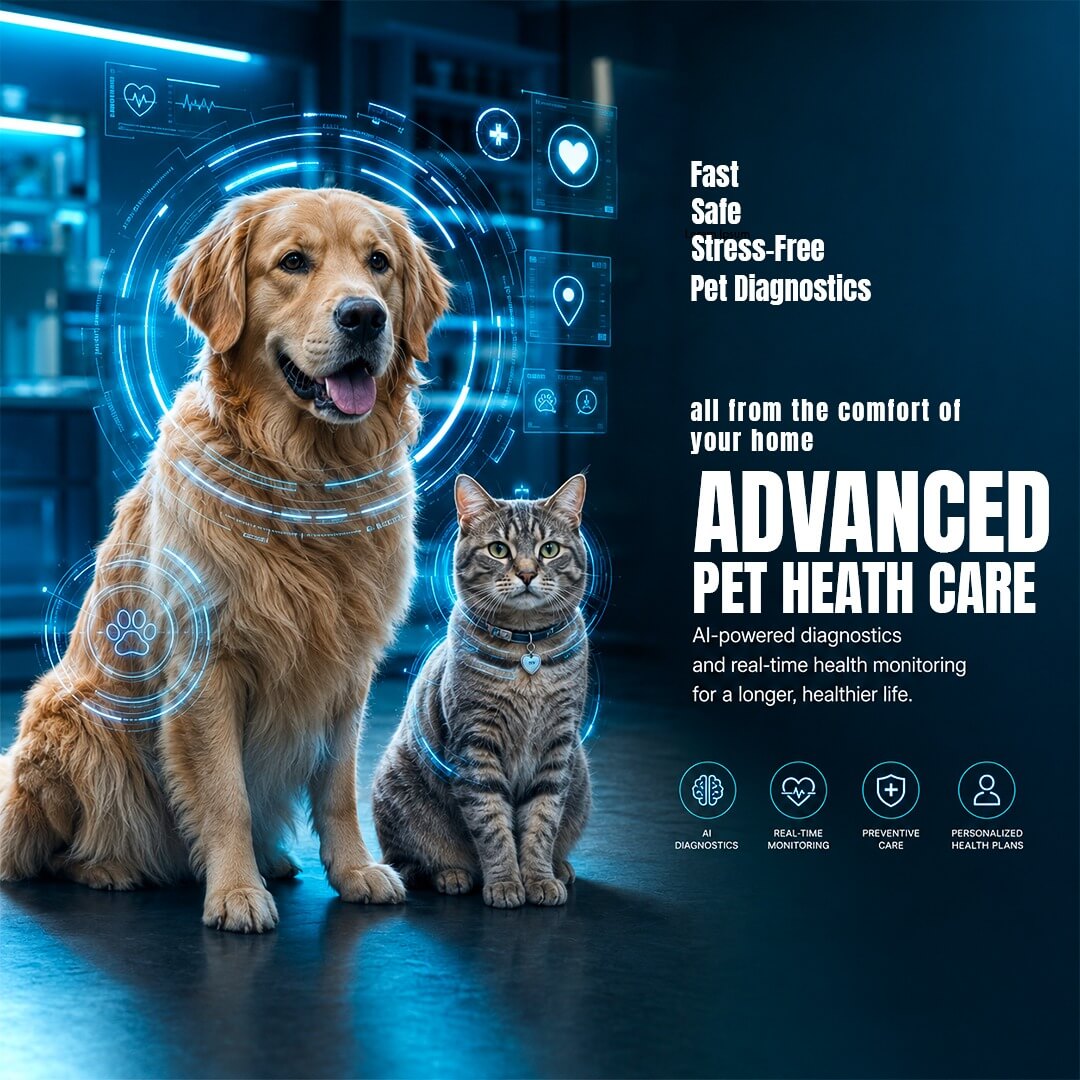
PetScan by mypetcall.com — India's First Free AI Pet Health Scanner That Checks Your Dog or Cat in 8 Seconds
What is PetScan — and why is it a game-changer for pet owners in India?
Every pet owner has had that moment — you look at your dog or cat and something feels slightly off. Their coat looks duller than usual. Their eyes seem cloudier. They are scratching more than normal. You are not sure whether it is serious enough to book a vet visit, or whether it will pass on its own. In India, where quality veterinary access remains uneven across cities and rural areas, and where the cost of unnecessary clinic visits adds up quickly, most pet owners simply wait and worry. PetScan by mypetcall.com is built to end that waiting and eliminate that uncertainty — forever. PetScan is India’s first free, AI-powered pet health scanner that analyses a photograph of your dog or cat across 9 key health biomarkers and delivers a detailed, clinically structured health report in just 8 seconds — completely free, from any device, anywhere in India. Try it right now at petscan.mypetcall.com and get your pet’s health report before you finish reading this article.
How does PetScan work? The science behind the 8-second health report
PetScan is powered by DeepVet-CV — a proprietary computer vision engine developed and maintained by the mypetcall.com Lab India team, trained on over 50,000 clinical cases and benchmarked at 96.2% accuracy across key health indicators. The entire process — from photo upload to completed clinical report — takes an average of just 8 seconds. Here is exactly how it works, step by step:
- Step 1 — Capture – You upload or take a high-resolution photograph of your dog or cat through the PetScan interface at petscan.mypetcall.com/form.php. The interface provides clear guidance on the optimal angle and framing for capturing your pet’s eyes, nose, coat, and overall posture — ensuring the AI receives the best possible input data for accurate analysis.
- Step 2 — Deep Scan – The DeepVet-CV model receives your photograph and immediately begins its analysis. The AI forensically segments the image into distinct anatomical regions, comparing pixel density, colour mapping, texture analysis, and structural geometry against a database of over 10,000 clinical pathology images. Each of the 9 health biomarker zones is assessed independently, scored against a “perfect health” baseline specific to your pet’s species and breed type, and assigned a severity rating from Normal through to Moderate and Critical.
- Step 3 — Report – Within 8 seconds, you receive a detailed, structured clinical health report covering all 9 biomarker zones. The report includes individual severity scores for each health area, specific findings written in clear, accessible language, and immediate veterinary guidance — including a recommendation to consult one of mypetcall.com’s online vet doctors if Moderate or Critical issues are detected. The report is downloadable as a digital document, making it easy to share directly with your local veterinarian.
What are the 9 health biomarkers that PetScan analyses?
The DeepVet-CV engine inside PetScan analyses 9 distinct anatomical and physiological health zones in every scan. Each zone is assessed independently against a comprehensive database of healthy and pathological reference images, giving you a granular, zone-by-zone picture of your pet’s health rather than a vague general impression. The 9 biomarkers are:
- 1. Coat Quality – The AI analyses coat density, texture, lustre, and uniformity across the visible fur area. Key indicators assessed include signs of alopecia (abnormal hair loss), matting, thinning, dullness, discolouration, and uneven shedding patterns — all of which can be early indicators of nutritional deficiencies, hormonal imbalances, parasitic infestation, or allergic reactions.
- 2. Skin Health – PetScan evaluates visible skin areas for signs of erythema (redness), hyperpigmentation, scaling, crusting, pustules, and abnormal skin texture changes. Skin health is one of the most diagnostically valuable indicators of systemic health in dogs and cats — and one of the earliest visible signs of conditions ranging from food allergies to fungal infections and autoimmune disorders.
- 3. Eye Clarity – The ocular analysis module examines the eyes for opacity (a key indicator of cataract formation), discharge, conjunctival redness, abnormal pupil presentation, and the general brightness and clarity of the eye surface. The system is calibrated to distinguish between normal breed-specific eye characteristics — for example, the natural droopiness of a Bloodhound versus the alert openness of a German Shepherd — to prevent breed-based false positives.
- 4. Ear Health – Visible ear canal area and ear flap condition are assessed for signs of discharge, excessive wax accumulation, redness, swelling, and abnormal texture — all common indicators of ear infections (otitis externa), ear mites, and foreign body presence, which are among the most frequently missed health issues in Indian pet owners’ home assessments.
- 5. Nose Texture – The nasal surface is analysed for its moisture level, texture uniformity, crust formation, discolouration, and the presence of discharge. A healthy dog or cat nose should be smooth and slightly moist — dry, cracked, or heavily crusted nasal presentation can indicate dehydration, distemper, autoimmune conditions, or environmental sensitivities.
- 6. Oral Hygiene – Where visible in the submitted photograph, the AI assesses lip and muzzle areas for signs of dental disease indicators — including perioral staining, swelling, and abnormal discharge — while flagging any visible gum colouration abnormalities that might suggest systemic health concerns.
- 7. Paw Condition – Paw pad surface, interdigital skin, and visible nail condition are evaluated for cracking, swelling, redness, abnormal colouration, and signs of licking-induced trauma — a common symptom of contact allergies, pododermatitis (paw inflammation), and obsessive stress behaviours.
- 8. Mobility & Posture – The AI analyses your pet’s overall body posture and stance as captured in the photograph, assessing for asymmetry, hunching, unusual weight distribution, and visible signs of discomfort or pain — indicators that can point to musculoskeletal issues, joint pain, or neurological conditions.
- 9. General Vigour – A composite assessment of overall body condition score, visible alertness, posture confidence, and the general physical presentation of the animal — providing a holistic health impression that contextualises the individual biomarker findings into a complete clinical picture.
Why does early pet health detection matter so much in India?
India is home to an estimated 35 million pet dogs and over 5 million pet cats — and that number is growing at an unprecedented rate, driven by a generation of first-time pet owners across Tier 1 and Tier 2 cities who are more educated, more invested, and more emotionally connected to their pets than any previous generation in the country’s history. Yet despite this surge in pet ownership, the infrastructure for preventive veterinary care has not kept pace. Most Indian pet owners rely on reactive care — they visit a vet when something is visibly wrong, often weeks or months after the earliest warning signs first appeared. The consequences of this delay are significant:
- Conditions caught late are more expensive to treat – A skin infection detected in its early erythema stage costs a fraction of what it costs to treat once it has progressed to a secondary bacterial infection requiring antibiotics, medicated shampoos, and multiple clinic visits.
- Some conditions are irreversible if missed early – Progressive retinal atrophy, early-stage cataracts, and chronic ear infections that cause permanent hearing damage are all conditions where early detection is the difference between management and irreversible damage.
- Veterinary access remains unequal across India – While metro pet owners in Mumbai, Delhi, Bengaluru, and Pune have access to quality veterinary clinics, millions of pet owners in smaller cities and rural areas do not. An AI tool that delivers clinical-quality health insights from a smartphone photograph democratises preventive care in a way that physical infrastructure never could.
- Pet owners lack the clinical knowledge to self-assess accurately – Most pet owners love their animals deeply but lack the training to distinguish between a normal coat variation and the early signs of a mange infestation, or between normal eye moisture and the beginning of conjunctivitis. PetScan bridges this knowledge gap with a tool that is as easy to use as taking a selfie.
PetScan is mypetcall.com’s answer to this critical gap — a free, intelligent, always-available tool that gives every Indian pet owner the power of clinical-grade early detection in the palm of their hand.
How accurate is PetScan — and how is the AI trained?
The DeepVet-CV engine powering PetScan has been trained on a dataset of over 50,000 clinical veterinary cases and benchmarked at 96.2% accuracy across the key health biomarker categories. Several design decisions make this accuracy rate meaningful and reliable in real-world use:
- Breed-specific calibration – The model is tuned for distinct breed types and fur variations. Rather than applying a single universal “healthy” baseline across all dogs and cats, DeepVet-CV accounts for breed-specific anatomical characteristics — the naturally droopy eyelids of a Bloodhound, the deep skin folds of a Pug, the dense double coat of a Husky, or the large ears of a Basset Hound — to ensure that normal breed features are correctly classified and do not generate false positive alerts.
- Canine and feline optimisation – The system is separately optimised for both dogs and cats, recognising that the two species have fundamentally different anatomical structures, skin physiology, eye characteristics, and health risk profiles. The target species is identified automatically during scan initiation.
- Clinical pathology image database – Each biomarker is assessed against a reference library of over 10,000 clinical pathology images — real veterinary case photographs covering the full spectrum of presentation from healthy normal through to confirmed pathological conditions — giving the AI a robust and medically credible comparison foundation.
- Severity scoring system – Results are not presented as binary pass/fail outputs. Each biomarker receives a nuanced severity score across a spectrum — Normal, Mild, Moderate, Severe, Critical — allowing pet owners to prioritise which findings require immediate veterinary attention and which can be monitored over time.
- Continuous model improvement – The DeepVet-CV model is maintained and updated by the mypetcall.com Lab India development team, with ongoing calibration based on accumulated scan data and veterinary feedback to continuously improve real-world performance.
It is important to note that PetScan is designed as a screening and early detection tool, not as a replacement for professional veterinary diagnosis. When Moderate or Critical severity findings are detected, PetScan explicitly recommends downloading the report and sharing it with a licensed veterinarian — or consulting one of mypetcall.com’s qualified online vet doctors directly through the platform.
Is my pet’s photo and data safe with PetScan?
Privacy and data security are not afterthoughts in the PetScan architecture — they are central design principles. Here is exactly how your data is handled:
- Ephemeral processing — zero permanent image storage – Your pet’s photograph is processed on secure edge servers using an ephemeral processing model. This means the image is analysed in real time and then immediately discarded — it is not stored permanently on any server after the analysis is complete. You upload a photo, get a report, and the image is gone. No database of your pet’s photographs is built or retained.
- Encrypted edge processing – All data transmission between your device and the PetScan processing servers is encrypted end-to-end, ensuring that your pet’s health information cannot be intercepted or accessed by any third party during the analysis process.
- No third-party data sharing – PetScan does not share your submitted photographs or your pet’s health report data with any third-party advertising, data brokerage, or commercial analytics platforms.
- Full transparency – PetScan’s complete terms of use and privacy policy are publicly available and clearly documented at petscan.mypetcall.com for any pet owner who wants to review them before submitting a scan.
Who should use PetScan — and how often?
PetScan is designed to be genuinely useful to every category of pet owner in India — not just those with sick pets or immediate health concerns. Here is who benefits most and how often they should be using it:
- New pet owners with puppies and kittens – The first year of a pet’s life is the most health-intensive, with rapid developmental changes that can be difficult for inexperienced owners to assess confidently. Running a PetScan every 4 to 6 weeks during kittenhood and puppyhood gives new owners a structured, clinical-quality health check alongside their scheduled veterinary visits — filling the significant monitoring gap between clinic appointments.
- Pet owners in cities with limited vet access – For the millions of Indian pet owners in Tier 2 and Tier 3 cities, towns, and rural areas where qualified veterinary clinics are scarce or distant, PetScan provides a level of professional health intelligence that was previously completely inaccessible. A scan can determine whether a concern requires an urgent, multi-hour journey to the nearest vet clinic — or whether it can be safely monitored at home for a few days.
- Owners of senior dogs and cats (7+ years) – Senior pets develop health issues more rapidly and with less visible warning than younger animals. Monthly PetScan assessments for senior dogs and cats create a consistent health monitoring baseline — making it far easier to detect changes over time that might otherwise be missed until they become serious.
- Pet owners monitoring a known health condition – For dogs or cats already diagnosed with skin allergies, ear infections, coat conditions, or eye issues, PetScan provides a quick, zero-cost tool to monitor treatment progress and assess whether a condition is improving, stable, or worsening between scheduled veterinary follow-up appointments.
- Any pet owner who noticed something “slightly off” – The single most common scenario PetScan is built for — that moment when you look at your pet and something feels different but you cannot quite articulate what it is. PetScan turns that instinct into clinical data in 8 seconds.
For healthy adult pets, mypetcall.com recommends running a PetScan once every 4 to 8 weeks as part of a routine preventive health monitoring schedule — alongside a quality, nutritionally complete diet from trusted brands like those reviewed in the mypetcall.com Royal Canin guide and the Henlo dog food guide.
How PetScan fits into the complete mypetcall.com pet care ecosystem
PetScan is not a standalone product — it is the health intelligence layer of a complete, end-to-end pet care platform that mypetcall.com has built to serve every need of the modern Indian pet owner. Here is how PetScan connects with the rest of the mypetcall.com ecosystem to create a genuinely joined-up pet health experience:
- PetScan detects → Online Vet Consultation resolves – When PetScan identifies a Moderate or Critical issue in any of the 9 biomarker zones, the report explicitly recommends consulting a qualified veterinarian. mypetcall.com makes this the next immediate step by offering direct access to licensed online vet doctors — qualified professionals available for video and chat consultations who can review your downloaded PetScan report and provide clinical guidance without requiring a physical clinic visit.
- PetScan monitors → Nutrition from mypetcall.com supports – PetScan findings — particularly coat quality, skin health, and general vigour scores — are directly influenced by the nutritional quality of your pet’s daily diet. If your dog or cat’s scan flags concerns in these areas, the mypetcall.com product range offers India’s widest selection of premium pet food, supplements, and treats — all at up to 15% below market price — with brands including Royal Canin, Henlo, Me-O, Smylo, and many more.
- PetScan educates → mypetcall.com Blogs deepen understanding – When a PetScan report highlights a specific health concern, the mypetcall.com blog library provides detailed, accessible articles on nutrition, breed-specific health, product guides, and preventive care — giving pet owners the contextual knowledge to understand their pet’s health report and take informed next steps.
Together, these three pillars — AI health scanning, online vet consultation, and premium pet products at below-market prices — make mypetcall.com the most complete and technologically advanced pet care platform available in India today. To learn more about what makes mypetcall.com unique, read the best pet care website in India guide.
How to get started with PetScan in 3 simple steps
Getting your pet’s first AI health scan takes less than two minutes from start to report. Here is everything you need to know to get the best possible result from your first PetScan:
- Step 1 — Photograph your pet correctly – Take a clear, well-lit photograph of your dog or cat in good natural or indoor light. Ensure your pet is stationary and the image is in sharp focus. For the most comprehensive scan, a three-quarter front-facing angle that captures the face, eyes, nose, ears, and coat simultaneously is ideal. Avoid flash photography, extreme shadows, or heavily filtered images as these reduce the AI’s analytical accuracy.
- Step 2 — Upload and initiate your scan – Visit petscan.mypetcall.com/form.php from any device — mobile, tablet, or desktop. Upload your photograph through the guided interface, confirm your pet’s species (dog or cat), and initiate the scan. The DeepVet-CV engine will begin processing immediately.
- Step 3 — Receive and act on your report – Within 8 seconds, your 9-point clinical health report will be ready. Read through each biomarker finding carefully. Download the report as a PDF for your records. If any finding is rated Moderate or Critical, book a consultation with one of mypetcall.com’s online vet doctors immediately and share the downloaded report to give them the clearest possible picture of your pet’s current health status.
PetScan is completely free. No account creation required. No subscription. No hidden fees. Just upload a photo and know how your pet is doing — in 8 seconds.
Your pet cannot tell you when something is wrong. But their body can — if you know how to look. PetScan by mypetcall.com is the tool that teaches you to look with clinical precision, in 8 seconds, from the phone in your pocket, completely free. Powered by DeepVet-CV, trained on over 50,000 clinical cases, benchmarked at 96.2% accuracy, and built specifically for Indian pet owners and the unique health needs of dogs and cats in the Indian environment — PetScan is not just a feature. It is the future of preventive pet care in India. Do not wait until something looks seriously wrong. The earlier you detect it, the better the outcome. Run your free pet health scan right now at petscan.mypetcall.com — and discover more about keeping your pet healthy at the mypetcall.com blog.